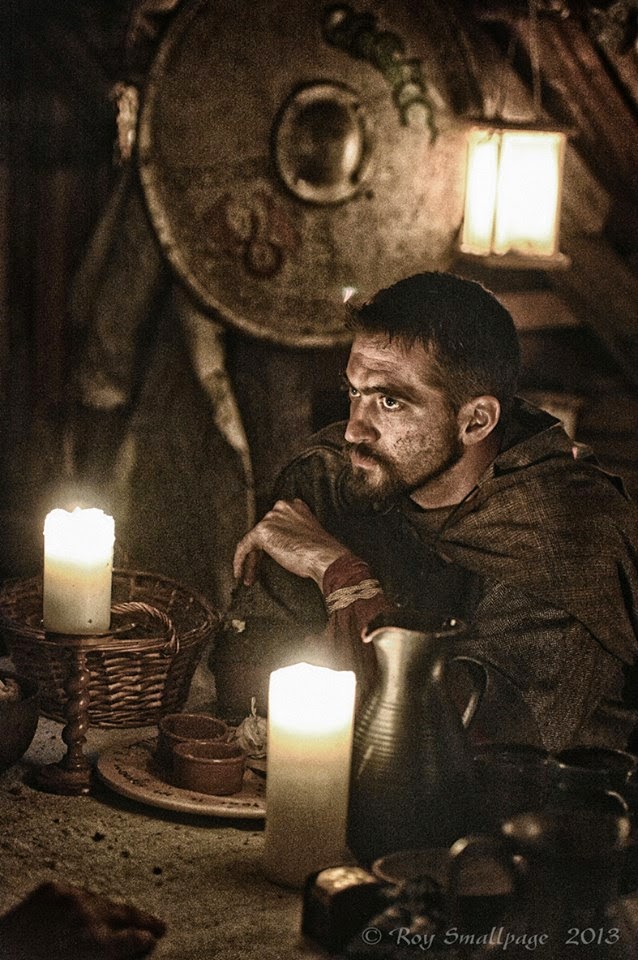
"Goddard leapt the ale barrels without breaking stride, vaulted the first table, dodged a chair in her path and slammed a drunk out of her way.
‘Foresters’ she shouted, as if the mail and the harness didn’t give it away. She received a growl from the assembled, but no one blocked her. They knew better, spilt beer or no. She was the fucking law"
You'll recall that I was kicking off a new project - a bit of fun I'm calling 'Foresters'.
It's an episodic miniseries featuring a grubby trio of Nottingham lawmen, working one of England's most dangerous beats in 1191AD.
The Extract is the slightly longer-than-usual pilot episode to introduce a few recurrent characters.
It's big and brash and stupid but hopefully you'll agree that it's also a lot of fun.
It's a lot more 'police' than my Novel about Robin Hood, and this makes it a little more fantasy, a little less history, but think 'medieval cop-show' and you've nailed it.
As before, I feel the sudden need to mention that it is in no way a thinly veiled ramble through some of my own police experiences, seen through a flimsy historical filter (no, wait, that's exactly what it is).
Click here for Extract and enjoy, share, comment.
-Tom
photo by Roy Smallpage
Monday, 13 April 2015
Tuesday, 7 April 2015
A Nasty way to Start the Show
'Cutthroat' is my take on the Robin Hood legends.
Its a grim low-fantasy reworking of the medieval ballads, drawing experiences and language from my time as a UK police officer and medieval reenactor.
I wanted to get the first three chapters up here to share with you, while I go through the process that everyone has to: trying to navigate the world of conventionally publishing it.
As for the action: It covers the opening frame of the novel and the drawing of William Scathlock into banditry and crime. It's a nasty look at how easy it is to step off the path and be lost in Norman England, and a good window into a world that wasn't all Disney and Costner and Merry Men
No golden arrows, no fights with giants, no heroes... just Cutthroats.
Its a grim low-fantasy reworking of the medieval ballads, drawing experiences and language from my time as a UK police officer and medieval reenactor.
I wanted to get the first three chapters up here to share with you, while I go through the process that everyone has to: trying to navigate the world of conventionally publishing it.
As for the action: It covers the opening frame of the novel and the drawing of William Scathlock into banditry and crime. It's a nasty look at how easy it is to step off the path and be lost in Norman England, and a good window into a world that wasn't all Disney and Costner and Merry Men
No golden arrows, no fights with giants, no heroes... just Cutthroats.
Monday, 6 April 2015
Editing: Time at the Coalface
I actually like editing. There, I said it.Most people hate chopping and thrashing through the process, not me; I actually like taking the hatchet to the text
I've spent a disproportionate amount of time editing over the last week, and those of you who follow me on twitter will have seen the result: a pale, shadow of a guy with a weird, haunted look who mumbles to himself about oxford commas and character progression.
By doing this I've hammered the first chunk of Cutthroat into a really neat self contained extract, and I'm actually rather proud of the result.
I'm also going to make sure there's a bit of the edited extract up here and getting it done means that I can get Foresters up on the blog this week as another fun read for fans of grim medieval fantasy.
In the mean time, I'll be at my keyboard.
-Tom
Tuesday, 31 March 2015
Monday, 23 March 2015
You know how to shoot that thing?
Archery.
Can't write about the history of Medieval England without archery. The nation's been at it's most warlike when archery has been a fashionable pastime. You can argue the point (and please do, that's what the comment box is for) that England's success in medieval overseas conflict went into decline as the bow itself declined in popularity.
Young people stopped shooting, and so didn't grow up to keep shooting all over Christendom.
With archery popular at the same time that the early Robin Hood ballads were popular it's no surprise that the outlaws were depicted as archers. These were songs and plays for pubs. If the sport of the day had been football, they would have been footballers.
In the ballads, archery is used more as a sporting contest than deadly combat. Hood rarely shoots it out with an enemy, and rarely kills with the bow. Most of the time Hood and his opponent set a wand in the ground and shoot at this, with the winner being he that shoots closest.
Violence, when it happens in the poems is usually settled with swords.
Now personally, I've ignored this 'sportsmanlike' behaviour in my own novel. Looking at it with an ex-copper's set of eyes, the average bloke in 12C England had a social (and later, legal) obligation to practice with a bow, and often, a need to steal to feed himself.
It's the equivalent of every single person being trained to shoot, and having a gun in their home, but not enough money to eat.
Of course those bows are going to get used for violence.
side note - The practice of shooting at wands is pretty common in the ballads. It bears a striking similarity to 'clout archery'; shooting at pennants still practiced today.
I'm interested in the idea that archery is on the rise again.
It's getting popular.
It's attracting attention.
Lets just keep it sportsmanlike though, eh?
As a parting shot, take a look at http://markstretton.blogspot.co.uk/ (see the note in the sidebar) on differences between modern shooting technique and medieval stance and draw, and the incredible 200lb draw bow!
-Tom
Can't write about the history of Medieval England without archery. The nation's been at it's most warlike when archery has been a fashionable pastime. You can argue the point (and please do, that's what the comment box is for) that England's success in medieval overseas conflict went into decline as the bow itself declined in popularity.
Young people stopped shooting, and so didn't grow up to keep shooting all over Christendom.
With archery popular at the same time that the early Robin Hood ballads were popular it's no surprise that the outlaws were depicted as archers. These were songs and plays for pubs. If the sport of the day had been football, they would have been footballers.
In the ballads, archery is used more as a sporting contest than deadly combat. Hood rarely shoots it out with an enemy, and rarely kills with the bow. Most of the time Hood and his opponent set a wand in the ground and shoot at this, with the winner being he that shoots closest.
Violence, when it happens in the poems is usually settled with swords.
Now personally, I've ignored this 'sportsmanlike' behaviour in my own novel. Looking at it with an ex-copper's set of eyes, the average bloke in 12C England had a social (and later, legal) obligation to practice with a bow, and often, a need to steal to feed himself.
It's the equivalent of every single person being trained to shoot, and having a gun in their home, but not enough money to eat.
Of course those bows are going to get used for violence.
side note - The practice of shooting at wands is pretty common in the ballads. It bears a striking similarity to 'clout archery'; shooting at pennants still practiced today.
I'm interested in the idea that archery is on the rise again.
It's getting popular.
It's attracting attention.
Lets just keep it sportsmanlike though, eh?
As a parting shot, take a look at http://markstretton.blogspot.co.uk/ (see the note in the sidebar) on differences between modern shooting technique and medieval stance and draw, and the incredible 200lb draw bow!
-Tom
Sunday, 22 March 2015
Kirklees Priory - an Extract from Cutthroat.
'Cutthroat', was my first full-length book. It's something I threw together as a re-imagining of the Robin Hood ballads, portraying Hood as an enterprising career criminal on the way up.
I re-wrote the plotlines from the Robin Hood ballads to correspond to the attitudes of the violent criminals I saw in my time as a police officer.
This extract (Chapter 10 of the book) is a reworking of 'Robin Hood and Alan Adale' into a heist, or a rescue, or a kidnapping (depending on your point of view).
No heroes here; just half a plan and half a chance...getting worse with every line.
I re-wrote the plotlines from the Robin Hood ballads to correspond to the attitudes of the violent criminals I saw in my time as a police officer.
This extract (Chapter 10 of the book) is a reworking of 'Robin Hood and Alan Adale' into a heist, or a rescue, or a kidnapping (depending on your point of view).
No heroes here; just half a plan and half a chance...getting worse with every line.
It's in 'Sample Scribblings' (over on the right).
Take a look, and if you want to, leave a comment, like or share.
-Tom
-Tom
photo by Roy Smallpage
Saturday, 21 March 2015
World Poetry Day - One from the Vault.
You would be forgiven for thinking that Additional MS. 27879 doesn't sound like an inspiring title for anything to do with World Poetry Day.
It refers to a near forgotten manuscript in the British Library's vast collection, just 520 or so pages (many of them worn so thin as to be illegible).
Known as the Percy folio, it contains about two hundred stories and ballads, written in the mid 1600's, describing tales and events stretching back to the mid 12th century.
They tell of Robin Hood.
Despite many of the original pages having been damaged through faulty binding, the ravages of time, or their original owner using them to light fires with, not all the stories were lost. fragments of 8 ballads remained, and it was these that formed the basis for the later, lighter, and altogether more pleasant stories of the 1883 collection by American scholar Francis James Child.
One of the original surviving ballads deals with the death of Robin Hood at what was probably Kirklees Priory, but notably, the death scene is one of the damaged pages, ending halfway through Robin's Plea to Little John:
And sett my bright sword at my head,
Mine arrowes at my feete,
And lay my yew-bow by my side,
My <and there is no more>
Though we're faced with the absence of a confirmed kill in the ballad ( though one is added later by Child) the prose does at least lead us to Kirklees priory.
It's there in the grounds, on a grave where we can find our verse for #WorldPoetryDay.
"Ne'er an archer was as him so good
And people called him Robin Hood.
Such Outlaws as he and his men
Will England never see again."
It refers to a near forgotten manuscript in the British Library's vast collection, just 520 or so pages (many of them worn so thin as to be illegible).
Known as the Percy folio, it contains about two hundred stories and ballads, written in the mid 1600's, describing tales and events stretching back to the mid 12th century.
They tell of Robin Hood.
Despite many of the original pages having been damaged through faulty binding, the ravages of time, or their original owner using them to light fires with, not all the stories were lost. fragments of 8 ballads remained, and it was these that formed the basis for the later, lighter, and altogether more pleasant stories of the 1883 collection by American scholar Francis James Child.
One of the original surviving ballads deals with the death of Robin Hood at what was probably Kirklees Priory, but notably, the death scene is one of the damaged pages, ending halfway through Robin's Plea to Little John:
And sett my bright sword at my head,
Mine arrowes at my feete,
And lay my yew-bow by my side,
My <and there is no more>
Though we're faced with the absence of a confirmed kill in the ballad ( though one is added later by Child) the prose does at least lead us to Kirklees priory.
It's there in the grounds, on a grave where we can find our verse for #WorldPoetryDay.
"Ne'er an archer was as him so good
And people called him Robin Hood.
Such Outlaws as he and his men
Will England never see again."
Subscribe to:
Posts (Atom)